
Join Us at the World Economic Conference in Orlando, Florida! Nov. 17-19, 2023
Join Us at the 2023 World Economic Conference in Orlando, Florida!
? Dates: November 17, 18, and 19 ? Location: Orlando, Florida, USA (or tune in from home with our virtual ticket options)
Are you ready to unlock the future of economics and finance? Prepare for an unforgettable World Economic Conference experience in sunny Orlando, Florida! This premier event is your gateway to insights, networking, and valuable resources that will supercharge your understanding of the global economy.
?️ What’s Included for In-Person Attendees:
- Event Admission: Enjoy reserved seating assigned based on the order of ticket sales, ensuring you have a prime view of every presentation.
- Presentation Slides: Gain access to the presentation slides from all speakers, allowing you to delve deeper into the topics discussed.
- Video Recording: Can’t make it to a session? No worries! You’ll receive access to video recordings of all conference presentations, so you can catch up at your convenience.
- WEC Event App: Connect with the conference on a whole new level. Access presentation slides, bonus reports, recordings, and more via the official WEC Event App.
- Bonus Conference Materials: Get a package of bonus conference-related materials, including exclusive bonus reports and videos (as provided by Martin Armstrong).
- Morning Information Sessions: Don’t miss out on important morning information sessions, screened on-site in the meeting room on Saturday and Sunday.
- Networking Opportunities: Exclusive access to the Event App Networking Feature allows you to connect with fellow attendees, both in-person and virtual, fostering valuable professional relationships.
- Culinary Delights: Savor delicious breakfast and lunch on Saturday and Sunday, prepared to keep you energized throughout the day.
- Cocktail Reception: Kick off the conference in style at our Friday evening cocktail reception. Meet and mingle with fellow attendees while enjoying refreshing drinks.
- Swag Bag: As a token of our appreciation, each in-person attendee will receive a swag bag filled with goodies, including an Armstrong Economics notebook, pen, and an event collector’s mug!
Unable to travel? We also have two different ticket options for those wishing to attend virtually!
Don’t miss this opportunity to be part of a global gathering of economic and financial minds. Secure your spot at the World Economic Conference in Orlando, Florida, and gain the knowledge, connections, and resources you need to thrive in the world of finance and economics.
Space is limited, so act now and reserve your seat! Visit our Events page to register and join us in sunny Orlando this November.
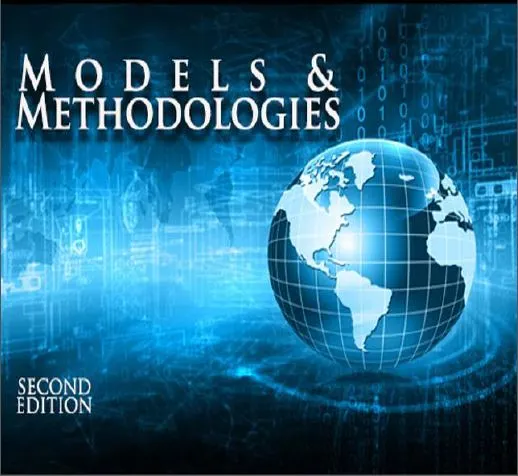


NEW BOOK Now Available : "Mark Antony & Cleopatra"
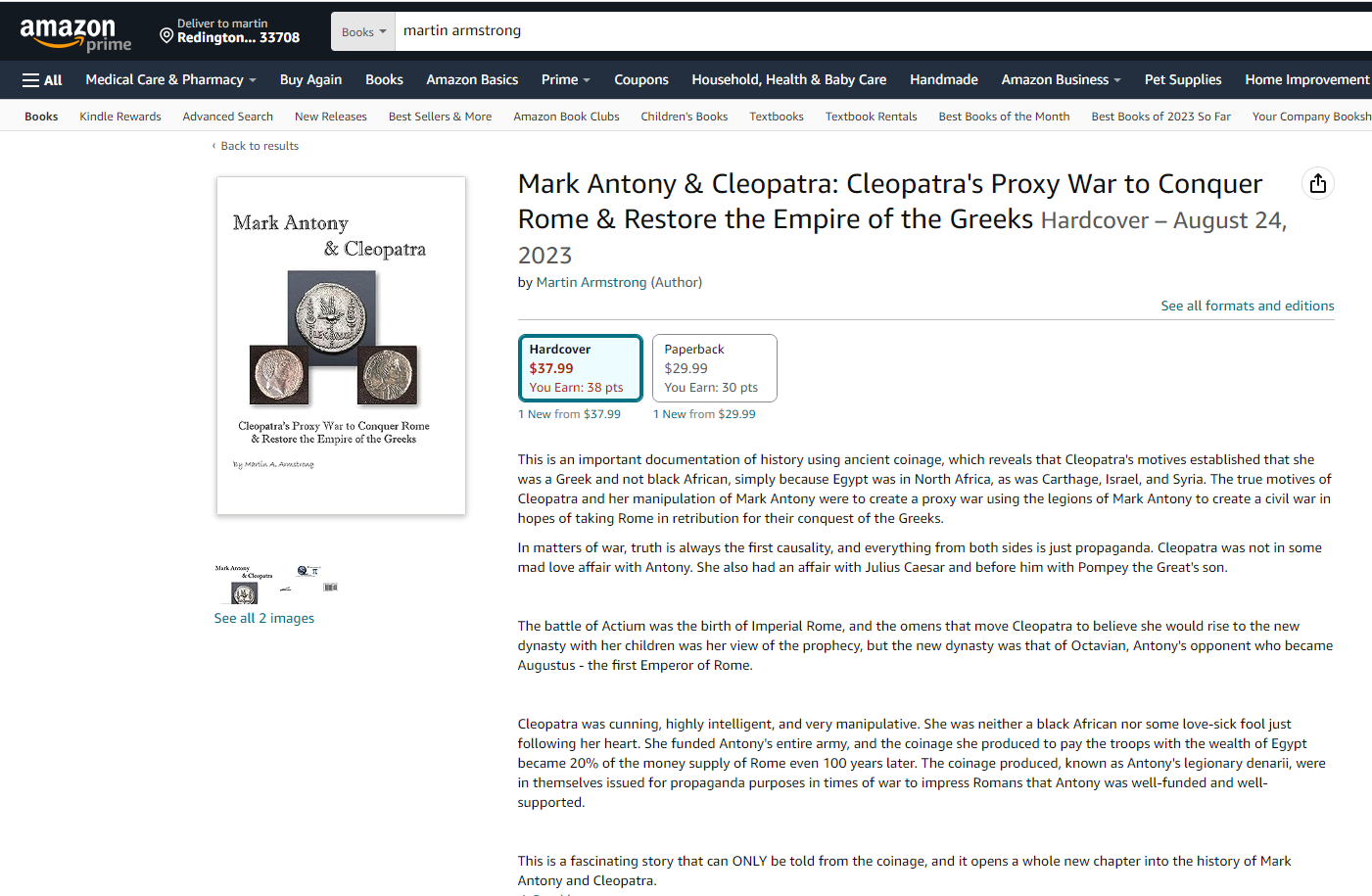
"THE PLOT TO SEIZE RUSSIA - THE UNTOLD HISTORY"
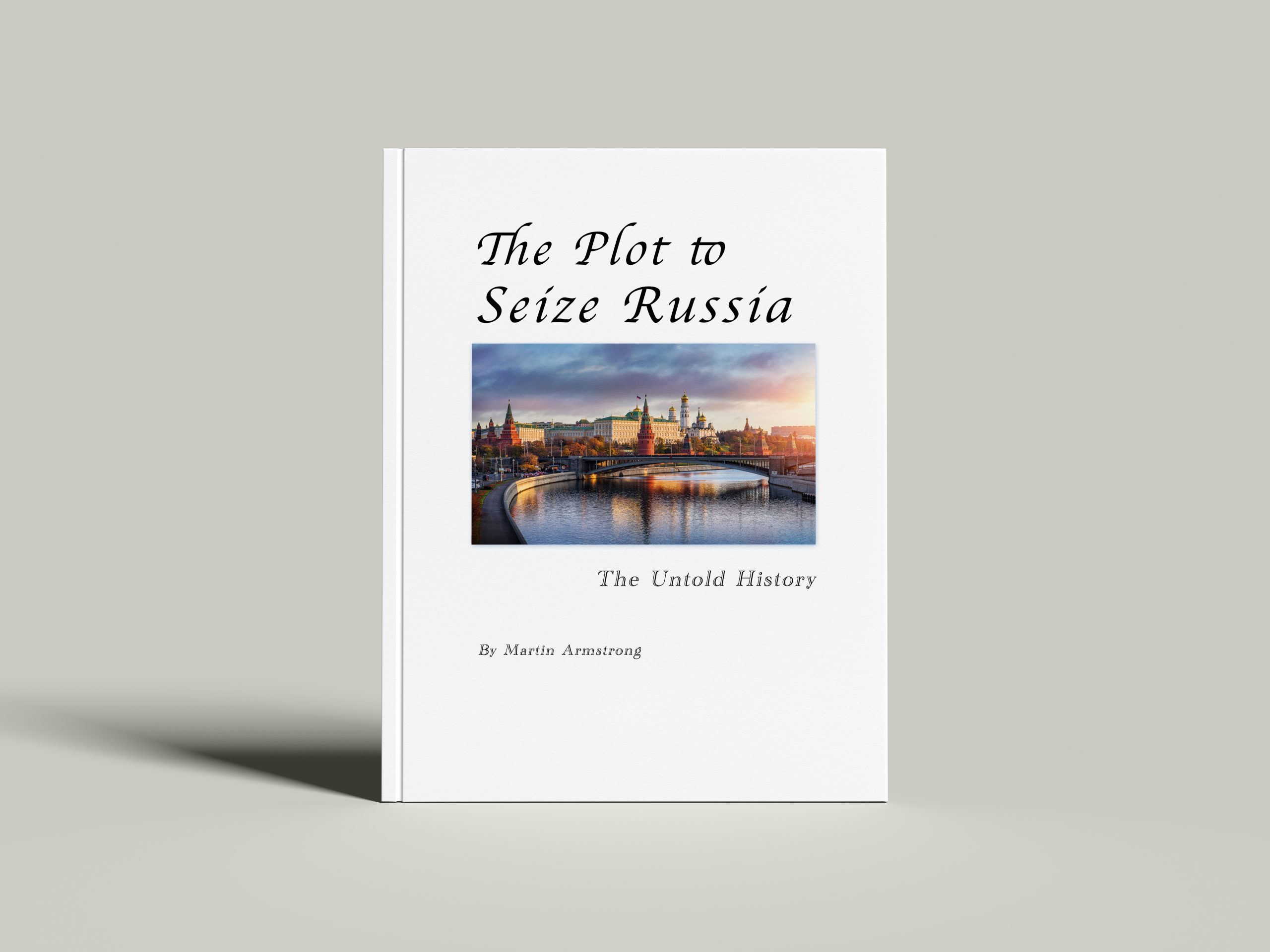
The second edition of “The Plot to Seize Russia – The Untold History” is now available for purchase in paperback and hardcover on Amazon and Barnes and Noble. The ebook will be available shortly.
Book description:
“Take care of Russia,” Boris Yeltsin said as he departed his presidency in August 1999. These words were directed at current Russian president, Vladimir Putin. Yeltsin specifically picked Putin as his predecessor to prevent the takeover of Russia.
So, who was Yeltsin warning against? Newly declassified documents from the Clinton Administration prove that there was a plot to rig the Russian election of 2000. These never-before-seen documents confirm numerous attempts to implement pro-Western policies using the Russian oligarchy headed by Boris Berezovsky.
On the other side were the communists who desired a return to the glory days of the Soviet Union. As one of the largest international hedge fund managers, author Martin Armstrong found himself in the middle of perhaps the greatest espionage, or attempt at a regime change for Russia, in modern history.
The Plot to Seize Russia pulls back the curtain to expose the most extraordinary attempt to seize power in modern history, but with the pen rather than armies. These declassified documents reveal a plot that has altered our thinking about the relations between the United States and Russia. The thirst for power comes seething through every line of these papers that alter our perception of reality, change the course of history, and now threaten us with World War III.
Market Talk – June 26, 2026

The Computer Was RIGHT About Gold
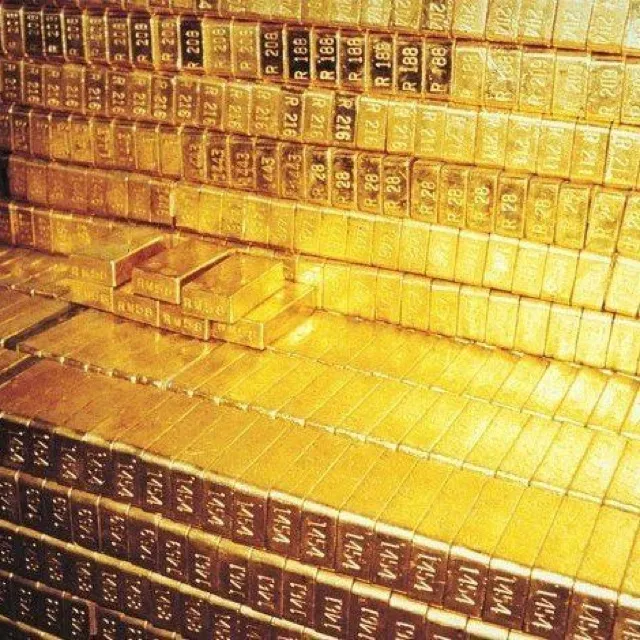
Gold has now fallen below $4,000 an ounce for the first time since November 2025, and suddenly everyone is proclaiming the bull market is dead. On June 24, spot gold fell to an intraday low of approximately $3,973.79, breaking below the $4,000 level for the first time in seven months. On June 25, gold remained under pressure, trading around $3,982.49. From its January record high near $5,595 an ounce, gold has now declined more than 28%, approaching the 30% correction our computer models had been pointing toward. Markets move in cycles, not straight lines. A correction of this magnitude frightens the late buyers into dumping their positions at precisely the time our computer indicated this washout would unfold.
During my latest interview with Mining, I warned that gold had become extremely overextended and that a major correction into this time period should surprise no one. I also explained that simply replacing the Federal Reserve chairman would not magically produce lower interest rates if inflation continued to accelerate. The market is now beginning to recognize that reality. Expectations for tighter monetary policy under Kevin Warsh, a stronger U.S. dollar, and reduced fears of an immediate Middle East escalation combined to create the perfect environment for a sharp liquidation.
What most analysts continue to miss is that a correction does not automatically signal the end of a secular bull market. The sovereign debt crisis has not disappeared. Europe’s financial problems have not been solved. Governments everywhere continue borrowing at unsustainable levels while geopolitical tensions remain elevated. Capital moves in waves, and violent corrections are a normal feature of every major bull market. During periods of international uncertainty, it is entirely possible for both gold and the U.S. dollar to strengthen together as capital flees political instability and sovereign debt risk around the world. Those who mistake a cyclical correction for the end of the trend usually discover they sold at exactly the wrong time.
This is why relying on opinion is so dangerous. The computer has no emotion, no political bias, and no personal agenda. It follows the movement of global capital. While everyone was chasing gold near $5,600 in January, the models warned that a significant correction was approaching. Now that fear has returned and commentators are declaring the bull market over after a decline to roughly $3,975, the majority is once again reacting emotionally instead of understanding the cycle. Markets rarely reward the majority. They reward those who recognize the trend beneath the volatility.
Inflation Remains Undefeated
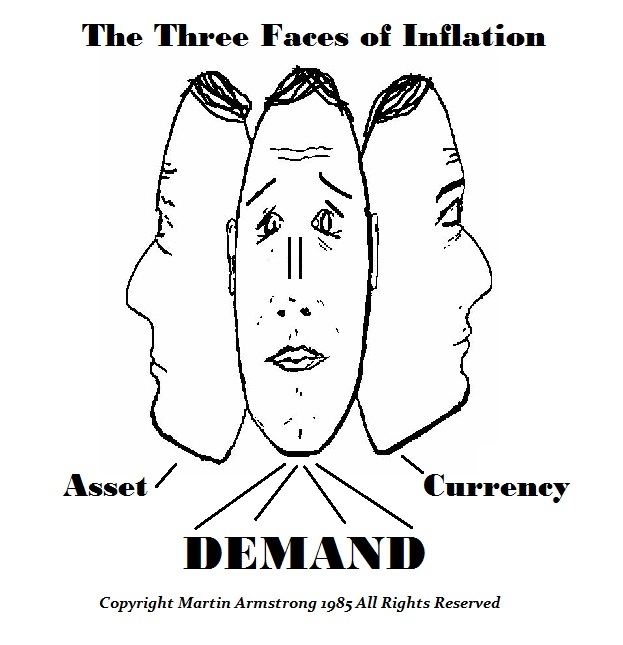
The Federal Reserve’s preferred inflation gauge just delivered another reminder that inflation has not been defeated. The Personal Consumption Expenditures (PCE) Price Index rose 4.1% year-over-year in May, the highest annual reading in three years, after climbing 0.4% during the month alone. Even stripping out food and energy, the so-called “core” PCE increased another 0.3% in May and now stands at 3.4% annually, still nearly double the Fed’s mythical 2% target. This is now the third consecutive month that inflation has accelerated rather than cooled. Meanwhile, consumer spending increased another 0.7% during May despite prices continuing to rise. People are still spending, but they are increasingly financing that spending by drawing down savings rather than enjoying genuine increases in purchasing power.
This is precisely why I have said repeatedly that simply replacing the Fed chairman changes nothing. Kevin Warsh inherits the same Keynesian institution that has governed monetary policy for decades. The politicians want lower interest rates because governments are drowning in debt and every percentage point increase dramatically raises interest costs. But central bankers cannot simply ignore inflation when it is moving back above 4%. Markets continue to fantasize that a new chairman somehow has a magic wand. That is political wishful thinking, not economics.
If inflation continues to reaccelerate, the pressure to raise rates will become overwhelming regardless of who occupies the chairman’s office. The Fed follows its mandate, and inflation above 4% leaves very little room for political fantasies.
Many commentators immediately blamed the increase entirely on higher oil prices during the recent Middle East conflict. Energy certainly contributed, but that explanation is far too simplistic. Core inflation excludes food and energy, yet it also accelerated to its highest level since late 2023. That tells us inflationary pressures have spread throughout the broader economy. Housing, services, transportation, insurance, labor costs, tariffs, and supply-chain disruptions all continue feeding higher prices. This is exactly why I have argued that reducing inflation to a single commodity price misses the broader cyclical forces driving the economy. Once inflation becomes embedded throughout the system, it becomes far more difficult to eliminate than politicians care to admit.
The markets continue to misunderstand another important point. Rising interest rates are not automatically bearish. Historically, rates tend to rise alongside strong capital concentration and expanding markets because money competes for returns. Rates generally collapse during bear markets and recessions when capital desperately seeks safety. We are entering a period where geopolitical instability, sovereign debt problems across Europe, and international capital flight continue funneling money into the United States. That capital flow can support both the U.S. dollar and financial markets even while interest rates remain elevated. The old Keynesian assumption that higher rates automatically destroy markets has repeatedly failed during previous international crises.
The broader issue extends far beyond one inflation report. Governments worldwide have accumulated debt levels that cannot realistically be serviced under permanently elevated interest rates. Every central bank now finds itself trapped between inflation and sovereign debt. Lower rates encourage inflation and currency instability. Higher rates increase government financing costs and expose the insolvency of highly indebted nations. That is why sovereign debt remains the defining issue of this decade. Inflation is not simply about gasoline or groceries. It is the symptom of governments that borrowed far beyond any sustainable level and now face the consequences.
Our models continue to point toward rising volatility into 2026 as the Panic Cycle unfolds. War, capital migration, sovereign debt stress, and declining confidence in government institutions are converging simultaneously. The latest PCE report is simply another confirmation that inflation has not disappeared. It merely paused before beginning its next advance. Those expecting a smooth return to the low-inflation world of the last decade are preparing for a future that no longer exists.
China Moves on Taiwan – Ethnic Unity Law

China has now openly declared that it believes it has the legal right to pursue people beyond its own borders under its new Ethnic Unity Law, which takes effect on July 1. Beijing insists the law is “legitimate, lawful, necessary, and feasible,” and argues that every nation has the right to suppress separatism. The legislation extends legal liability to individuals and organizations outside China accused of undermining what Beijing defines as “ethnic unity” or promoting separatism. This is no longer simply domestic legislation. It is a declaration that China intends to extend its legal reach far beyond its own borders.
The key nation to watch is Taiwan. Taipei immediately warned that the law could become another legal weapon against Taiwanese officials, politicians, academics, journalists, business leaders, and anyone Beijing considers supportive of independence. China has steadily expanded its legal framework over the past several years, beginning with sanctions, travel bans, and criminal guidelines aimed at so-called Taiwan separatists. Now it is broadening that authority by explicitly stating that people overseas can also be held accountable. This is another step in a process that has been unfolding piece by piece rather than overnight.
Taiwan has every reason to take this law seriously because Beijing has followed a similar playbook before. After imposing the National Security Law on Hong Kong in 2020, authorities steadily expanded its reach beyond the territory itself. Arrest warrants and bounties were issued for pro-democracy activists living overseas, passports were canceled, assets targeted, and pressure was applied to dissidents residing in Britain, Australia, and elsewhere. Hong Kong has also invoked national security powers against exiled activists abroad and offered financial rewards for information leading to their capture.
This new Ethnic Unity Law appears to follow the same pattern by creating another legal foundation that Beijing could use against Taiwanese politicians, academics, journalists, business leaders, and overseas supporters of Taiwanese independence. The first battle is always legal, the second is political, and only then does it become military. That is why Taiwan remains the critical flashpoint to watch as we move toward the 2027 War Cycle.
People continue looking only at military exercises and naval deployments, but the first stages of every major conflict are often legal, economic, and political. Governments create the legal justification long before they consider military action. Once laws are in place claiming jurisdiction beyond national borders, the political foundation has already been established.
This is why Taiwan remains the market everyone should be watching. The issue is no longer simply whether Beijing intends to reunify with Taiwan. The question is how far China is prepared to project its authority beyond its own borders. As sovereign debt pressures rise, geopolitical tensions intensify, and the global order continues to fracture, Taiwan remains one of the most significant pressure points in the world economy. Capital follows political risk, and our models continue to indicate that this region will remain one of the defining geopolitical stories of this decade.
Market Talk – June 25, 2026
AMERICAS:
US Markets:
- DJIA advanced by 71.72 points (0.14%) to 51,920.62
- S&P 500 declined by 0.73 points (-0.01%) to 7,357.49
- NASDAQ declined by 118.03 points (-0.46%) to 25,358.603
- Russell 2000 advanced by 21.24 points (0.71%) to 3,007.858
Canada:
- TSX Composite advanced by 114.12 points (0.33%) to 34,850.21
- TSX 60 advanced by 4.40 points (0.21%) to 2,054.08
Brazil:
- Bovespa advanced by 1,483.54 points (0.87%) to 171,990.20
India’s Russian Oil Imports Expose the Failure of Western Sanctions
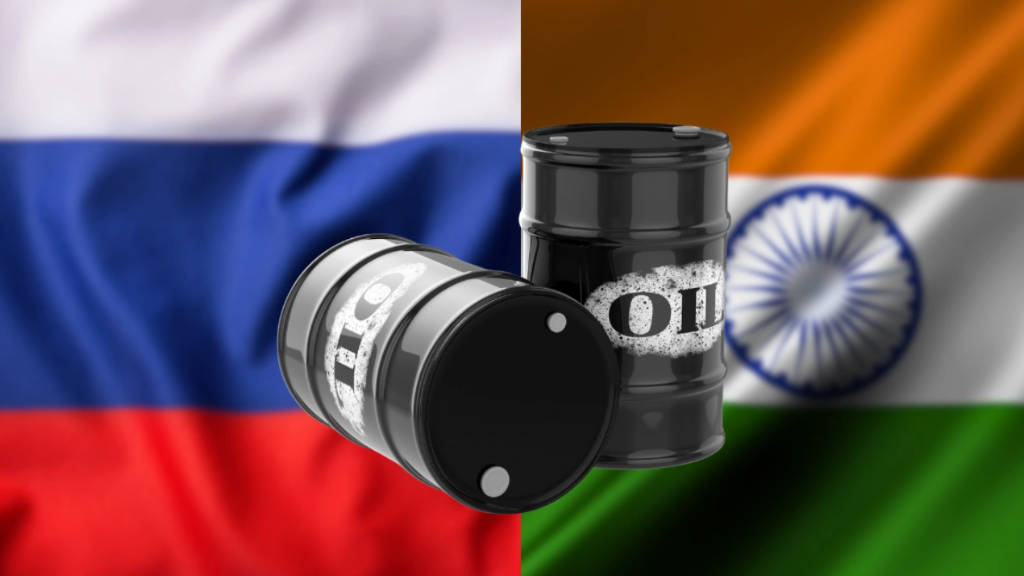
India’s imports of Russian crude oil have surged to a record high, with Moscow now supplying more than half of the country’s crude oil requirements. According to recent reports, Russian oil accounted for over 50% of India’s imports in June after a temporary US sanctions waiver expired. This development is far more significant than most people realize. It once again demonstrates that governments can impose sanctions, issue political declarations, and threaten economic consequences, but markets ultimately follow economic self-interest.
From the beginning, I argued that sanctions against Russia would not produce the outcome Western policymakers expected. Russia is not a small isolated economy. It is one of the world’s largest commodity producers. It exports oil, natural gas, fertilizers, metals, wheat, and countless other essential resources. The assumption that the world would simply stop buying Russian commodities ignored economic reality. Someone always buys discounted energy. In this case, India has emerged as one of the primary beneficiaries.
Before the Ukraine conflict, Russia supplied only a tiny portion of India’s crude imports. Today it has become India’s dominant supplier. Why? Because India is acting in its own national interest. Western governments may view energy through a geopolitical lens, but developing nations view it through the lens of economic survival. Cheap energy lowers production costs, supports industrial growth, and helps maintain economic competitiveness. India is not going to sacrifice its future to satisfy the foreign policy objectives of Brussels or Washington.
What makes this situation particularly revealing is that Europe itself continues finding indirect ways to consume Russian energy. Russian crude is refined in third countries and re-enters global markets in various forms.
The broader implication concerns the changing structure of the global economy. For decades, the United States and Europe largely dictated the rules of international commerce. That era is changing. Countries such as India, China, Saudi Arabia, Turkey, Brazil, and others are increasingly pursuing independent policies based on their own interests rather than automatically aligning with Western objectives. India’s continued expansion of Russian oil purchases is part of that larger trend.
What is remarkable is how many policymakers continue measuring success based on announcements rather than outcomes. The objective was supposedly to reduce Russia’s energy revenues. Instead, Russia redirected enormous volumes of crude toward Asia while maintaining a critical role in global commodity markets. India secured discounted supplies. China expanded purchases. New shipping networks emerged. Markets adapted exactly as they always do.
This is one reason our models continue pointing toward rising geopolitical and economic fragmentation into the years ahead. The world is dividing into competing spheres of influence. Nations are becoming less willing to subordinate their economic interests to foreign policy agendas crafted thousands of miles away. India’s record purchases of Russian oil are not simply an energy story. They are a sign of a much larger transformation in the global order. The sanctions era has revealed that governments can issue commands, but they cannot repeal economic reality. Markets always find a way.
A Foreign-Born Judge Says States Cannot Verify Citizenship Before Elections

Washington D.C. District Court Judge Sparkle Sooknanan, who was born in Trinidad and Tobago before later becoming a U.S. citizen, has blocked the Trump administration’s effort to expand the federal SAVE database so states could verify whether registered voters are American citizens. The Systematic Alien Verification for Entitlements (SAVE) system was specifically designed to allow government agencies to verify immigration and citizenship status. The administration’s position was simple: if federal law requires citizenship to vote in federal elections, then states should be permitted to verify citizenship using a federal database that already exists for that purpose.
The court argued that states could face administrative burdens and that eligible voters might be improperly affected, or in other words, upholding the Constitution is of less importance than defying Trump. What is astonishing is that we have now reached a point where verifying citizenship before voting is considered controversial. The government can verify your identity for taxes, employment, banking, travel, Social Security, military service, and immigration benefits, yet somehow, citizenship verification for elections is treated as an unacceptable burden.
This ties directly into what I wrote yesterday regarding the absurd position that virtually anyone in the world can influence American elections. Foreign governments spend millions lobbying Washington. Foreign corporations influence policy. Foreign media outlets shape public opinion. Foreign money finds countless paths into the political system. Yet when someone proposes verifying whether registered voters are actually citizens, the political establishment suddenly claims the process is too risky.
The Constitution does not grant voting rights to the entire world. The foundation of a republic is citizenship. If citizenship no longer matters when determining who participates in elections, then what exactly is citizenship? That is the question nobody wants to answer. Instead, we are told that asking the question itself is somehow inappropriate.
Time and again, courts appear willing to block virtually any measure associated with election verification, border enforcement, immigration control, or citizenship requirements if it originates from the wrong political camp. The public is not blind. Millions of Americans look at rulings like this and conclude that the institutions entrusted with upholding the law are increasingly detached from common sense.
Republics do not fail because people ask too many questions. They fail when institutions become afraid of answering them. Confidence is the foundation of every political system. Once confidence begins to erode, polarization accelerates, trust disappears, and society fragments into competing camps that no longer believe the rules are applied equally.
If citizenship is required to vote, then verifying citizenship should not be controversial. The fact that this has become one of the most divisive issues in modern politics tells us just how far the country has drifted from the principles upon which it was founded.
Politicians Never Spend Their Own Money
The Canadian government has quietly expanded the clothing allowances available to the Governor General, and the timing could not be more tone-deaf. While Canadians struggle with inflation, housing costs, and rising taxes, Ottawa has decided that the person already living in Rideau Hall requires even more taxpayer-funded support for wardrobes and official appearances. The Governor General currently earns a salary of roughly C$378,000 per year, lives in an official residence maintained at public expense, travels at taxpayer expense, receives staff support, security, transportation, and a lengthy list of other publicly funded benefits. Yet somehow that was not enough.
According to the revised guidelines, the annual clothing allowance for the Governor General has increased from C$100,000 to C$130,000. The maximum amount that can be spent on ceremonial attire has also increased substantially, while clothing purchased with public funds remains government property. Think about that for a moment. The average Canadian household is trying to figure out how to pay for groceries, rent, mortgages, insurance, and utility bills while government officials are debating whether C$100,000 a year is enough for clothing. The political class truly lives in a different universe.
What makes this even more absurd is that the Governor General’s office already receives millions of dollars annually to operate. Rideau Hall employs dozens of staff members, maintains extensive grounds, hosts official events, and receives funding for travel and hospitality.

This is the same mentality that drives every sovereign debt crisis. Governments become disconnected from the source of their funding. They begin treating taxpayer money as an unlimited resource rather than the product of someone else’s labor. Every expenditure can be justified. Every program becomes essential. Every privilege becomes a necessity. Meanwhile, the national debt continues to rise. Canada has already accumulated enormous federal and provincial debt burdens while interest costs continue climbing. Yet government spending rarely moves in only one direction.
To be fair, Rideau Hall deserves credit for clarifying that casual and business clothing cannot be billed to taxpayers and for limiting reimbursement to official ceremonial functions. However, the larger question remains unanswered. Why does government spending continue to expand in virtually every direction while citizens are repeatedly told they must accept higher taxes, lower living standards, and fewer opportunities? That is the question driving public anger across Canada and throughout the Western world.
The problem is not whether the Governor General spends C$100,000 or C$130,000 on clothing. The problem is that nobody in government appears capable of recognizing how ridiculous this looks to the people paying the bills. Inflation accelerated to 3.2% in May. Housing affordability is among the worst in the developed world. Food bank usage continues reaching record levels in many communities. Young Canadians increasingly believe they will never own a home. Against that backdrop, Ottawa is debating six-figure wardrobe budgets.
Market Talk – June 24, 2026
AMERICAS:
US Markets:
- DJIA advanced by 182.06 points (0.35%) to 51,848.90
- S&P 500 declined by 7.24 points (-0.10%) to 7,358.22
- NASDAQ declined by 110.40 points (-0.43%) to 25,476.636
- Russell 2000 advanced by 11.15 points (0.37%) to 2,986.629
Canada:
- TSX Composite declined by 191.29 points (-0.55%) to 34,736.09
- TSX 60 declined by 6.07 points (-0.30%) to 2,049.68
Brazil:
- Bovespa declined by 752.21 points (-0.44%) to 170,506.66
China, Russia, Iran, and Europe along with the rest of the World are Free to Vote in US Elections
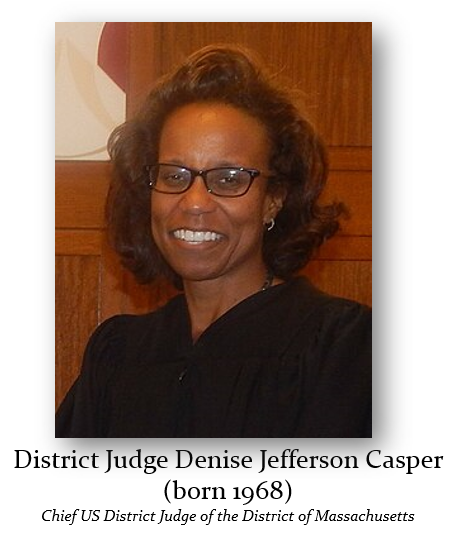
America, we have a problem. This is one judge who went out of her was to rule against Trump desperate to find not law, but an opinion that is a disgrace to the nation and she should be removed from office as a national security threat. In an order issued Wednesday, U.S. District Judge Denise L. Casper wrote that federal law and the Constitution give power to a president to manage elections.
“Our Constitution vests control over federal elections in the States, subject to some oversight by Congress.” She added: “While the Constitution vests the President with ‘executive power’ and commands him to ‘take Care that the Laws be faithfully executed,’ it does not grant the President any specific powers over elections.”
The ruling by Casper effectively converts a preliminary injunction that she had issued a year ago, in which she temporarily blocked many of Trump’s efforts to overhaul elections, into a permanent ban. She is not ruling that illegal aliens can vote, she is claiming Trump has no power to prevent non-Americans from voting. It figures, she is from Massachusetts and just because Trump is a republican he has to rule against him. She obviously has no problem allowing the entire world to now vote in US elections since the present has no authority to enforce the Constitution. Since the President has the duty to “faithfully” execute the law, then she is explicitly stating that there is no law to prevent the rest of the world from voting in US elections. Everyone is welcome.
I hope the Federal Court of Massachusetts get inundated with complaints. She should be disbarred for she is incapable of being not just impartial, but competent in comprehending the Constitution. Claiming there is no explicit clause to say only an American can vote, then what the hell, there is also noting to say someone cannot vote in every state simultaneously with mail-in ballots. When the Founding Father wrote the Constitution, they did not assume it applied worldwide.
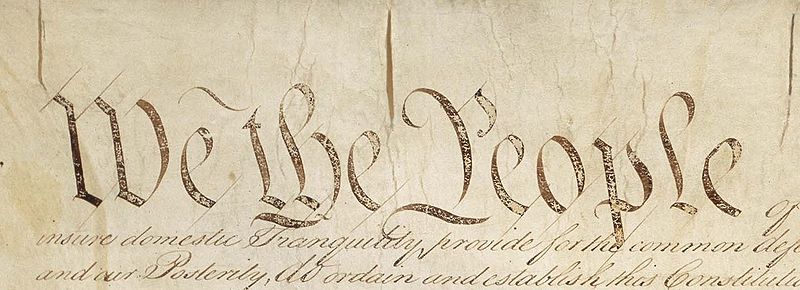
This phrase, “We the People,” is of paramount importance. We must look at the entire objective of creating the Constitution to fully comprehend its true meaning. If you were English and committed a crime in France, the French king could not punish you, for you were the property or “subject” of the English king. France would send you back in chains to England, explaining what you did, for only your sovereign had the jurisdiction to punish you – not where the crime occurred. This is incredibly important to understand.
Since the American Revolution was against the monarchy, why would they comply with international law at that time and send someone back to England for a crime committed in America to be punished by a king they did not recognize? The American Constitution established territorial jurisdiction for the first time. So, someone convicted of a crime would be punished in America for his crime in America. Now, the problem has become a question of rights under the Constitution. Did a foreign citizen have a right to a fair trial? The definition of “We the People” had to extend to anyone tried in America, regardless of their citizenship. There is nothing to indicate that this extended to a right for non-Americans to vote.
She has fulfilled our model. People will not longer trust any election because of people like her determined to impose their Marxist Agenda to destroy the American economy like Europe. Without CONFIDENCE in government, people will not buy the debt, sovereign defaults then follow, and pension funds are wiped out. Just like Marx and Lenin, everything has to be their way or no way. So, the world can now vote in America no problem. She is allowing illegals to vote because there is no clause that says they cannot. There is no indication that the Founding Fathers ever contemplated allowing Britain to interfere in American elections.